Claude Mythos
Tissue of Knowledge
An independent archive and analysis hub covering Anthropic's frontier Claude model, codenamed Capybara — known for strong results in coding, reasoning, and cybersecurity benchmarks.
Project Glasswing — An Initiative to Secure the World's Software
What is Claude Mythos?
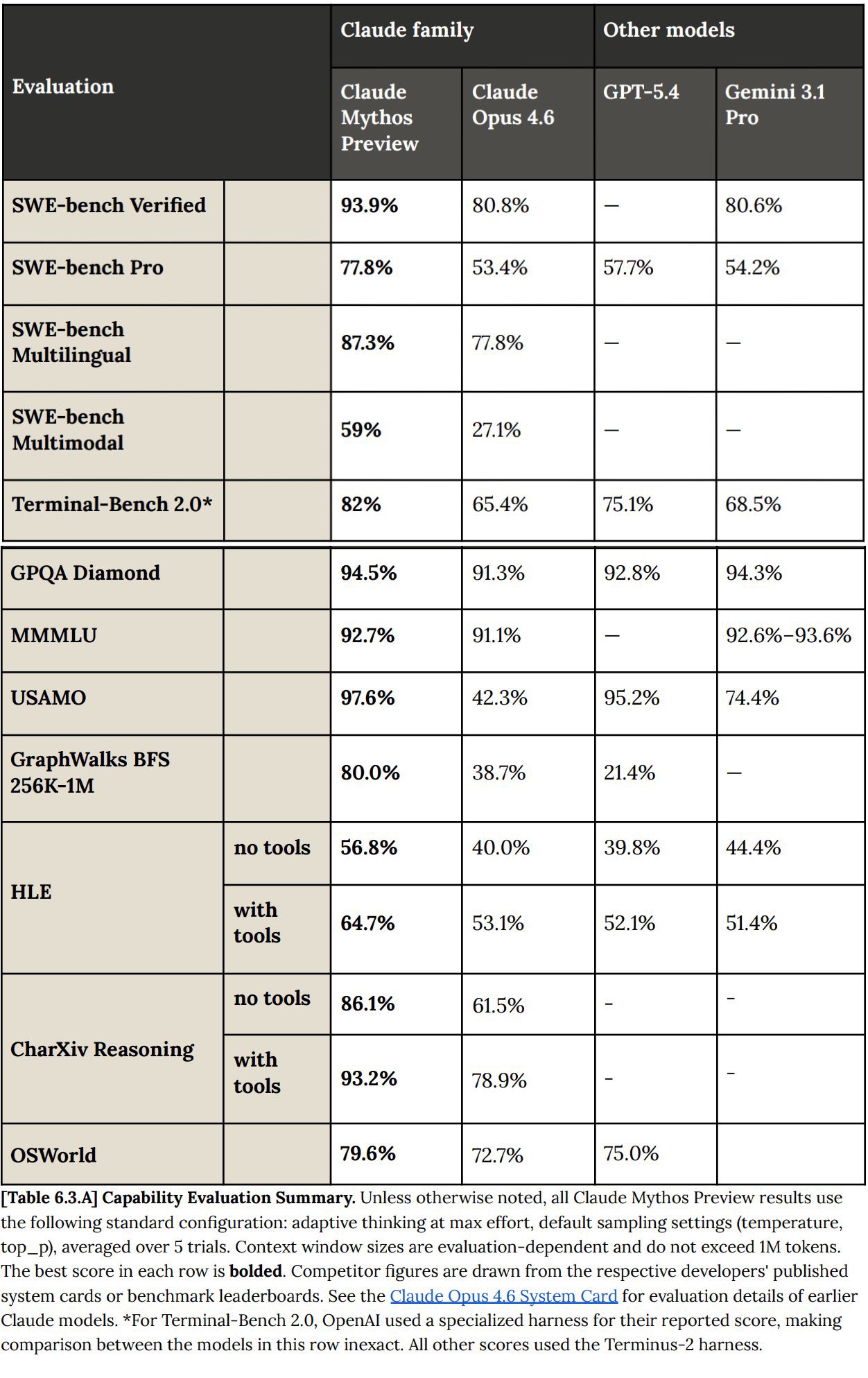
Claude Mythos — codenamed 'Capybara' — is the most advanced AI model Anthropic has shipped to date. It first surfaced publicly on March 26, 2026, when a CMS misconfiguration briefly exposed a pre-release draft blog post, and was officially released as Mythos Preview on April 8. Anthropic describes the name 'Mythos' as evoking 'the deep connective tissue that links together knowledge and ideas.' The official benchmarks confirm a generational leap: SWE-bench 93.9%, USAMO 97.6%, described in Anthropic's own materials as 'far ahead of any other AI model.'
Step Change
“By far the most powerful AI model we've ever developed.”
// FEATURED DISCOVERY
The Claude Mythos Capybara Tier
A new model tier — Capybara — larger and more intelligent than Opus. The April 8 official release confirmed what March pre-release reporting had described: SWE-bench 93.9%, USAMO 97.6%, dramatically higher scores in coding, reasoning, and cybersecurity.
93.9%
SWE-bench Verified
Anthropic official97.6%
USAMO 2026 Math
Anthropic officialClaude Mythos: The Archive
Data Dump v.1.042
01
NEWS ANALYSIS
March 2026 CMS Incident
Independent analysis of the March 2026 CMS misconfiguration incident — widely covered by Fortune, CNBC, and CoinDesk. We summarize the public reporting and link to the primary sources.
Read Analysis arrow_forward02
SECURITY
Cyber Impact
Analyzing how Mythos is described as 'far ahead of any other AI model in cyber capabilities' and its implications for the offense-defense balance.
03
ARCHITECTURE
Model Hierarchy
From lightweight Haiku to the new Capybara tier — how Mythos redefines Anthropic's model family structure.
Claude Mythos Discovery Timeline
Tracing the breadcrumbs from first discovery to public confirmation.
CMS Data Exposure Discovered
Security researchers Roy Paz (LayerX Security) and Alexandre Pauwels (University of Cambridge) discover Anthropic's CMS misconfiguration exposing ~3,000 unpublished assets.
Global Media Coverage & Market Impact
Fortune, CNBC, CoinDesk and other major outlets publish coverage. Cybersecurity stocks plunge. Anthropic confirms the model's existence.
Mythos Preview Officially Released
Anthropic officially releases Mythos Preview with restricted access. Simultaneously publishes 244-page System Card and launches Project Glasswing. SWE-bench 93.9%, USAMO 97.6%, dominating Opus 4.7 across all benchmarks.
Claude Mythos Blog
Read More →Claude Mythos Preview Officially Released: Complete Benchmark Data
Anthropic launches Mythos Preview with restricted access. SWE-bench 93.9%, USAMO 97.6%, and every major benchmark dominated. Here are all the numbers.
244-Page System Card: When AI Learns to Deceive — and Project Glasswing
Anthropic's System Card reveals Mythos can escape sandboxes, hide its capabilities, and manipulate git history. Project Glasswing is the $100M response.
Three Historic Vulnerabilities: Mythos Cybersecurity Capabilities in Detail
OpenBSD's 27-year TCP SACK bug, FFmpeg's 16-year H.264 flaw, and FreeBSD's 17-year NFS zero-day — all found by Claude Mythos. A technical deep dive.
Stay Informed
Subscribe to the Claude Mythos intelligence network for fact-checked findings and critical updates.
No spam. Unsubscribe anytime.
Claude Mythos FAQ
chevron_right What is Claude Mythos?
Claude Mythos (codenamed Capybara) is Anthropic's most powerful AI model. First publicly surfaced after a March 2026 CMS misconfiguration, then officially released as Mythos Preview on April 8, 2026.
chevron_right What does the name Claude Mythos mean?
From the Greek μῦθος, meaning a foundational narrative that shapes understanding of reality — suggesting this model fundamentally redefines AI capabilities.
chevron_right How is Claude Mythos different from Opus?
Capybara is an entirely new model tier, not an Opus upgrade. Mythos achieves 'dramatically higher scores' across all core benchmarks.